
The AS9100D Reality Check
Three months ago, I sat in a meeting with a Sydney-based aerospace contractor who was frustrated. Their local Australian manufacturer had just quoted $280,000 for a batch of titanium aerospace brackets with a 14-week lead time. They needed alternatives, but the procurement manager was skeptical about offshore suppliers.
"I've heard horror stories about quality issues with overseas manufacturers," he said. "How do I know an Indian supplier can actually meet aerospace standards?"
It's a fair concern. Aerospace and defence components aren't like regular manufacturing—there's zero tolerance for failure. A faulty bracket on an aircraft can have catastrophic consequences. The certification that separates amateur manufacturers from aerospace-grade suppliers is AS9100D.
Here's what that Sydney contractor discovered: we connected them with an Indian AS9100D certified supplier who delivered the same brackets for $168,000 in 10 weeks, with documentation and quality that passed their internal auditors on the first review.
The Growing Trend:
Over the past five years, Australian aerospace and defence companies have increasingly turned to Indian AS9100D certified manufacturers. The number of Australian companies with Indian aerospace suppliers has grown by over 180% since 2019, and it's not because they're compromising on quality—it's because they're finding equivalent or better quality at significantly lower costs.
This article explains exactly why this shift is happening, what AS9100D certification really means, and how Australian companies are successfully leveraging Indian aerospace manufacturing without compromising on safety or quality.
What AS9100D Actually Means (And Why It Matters)
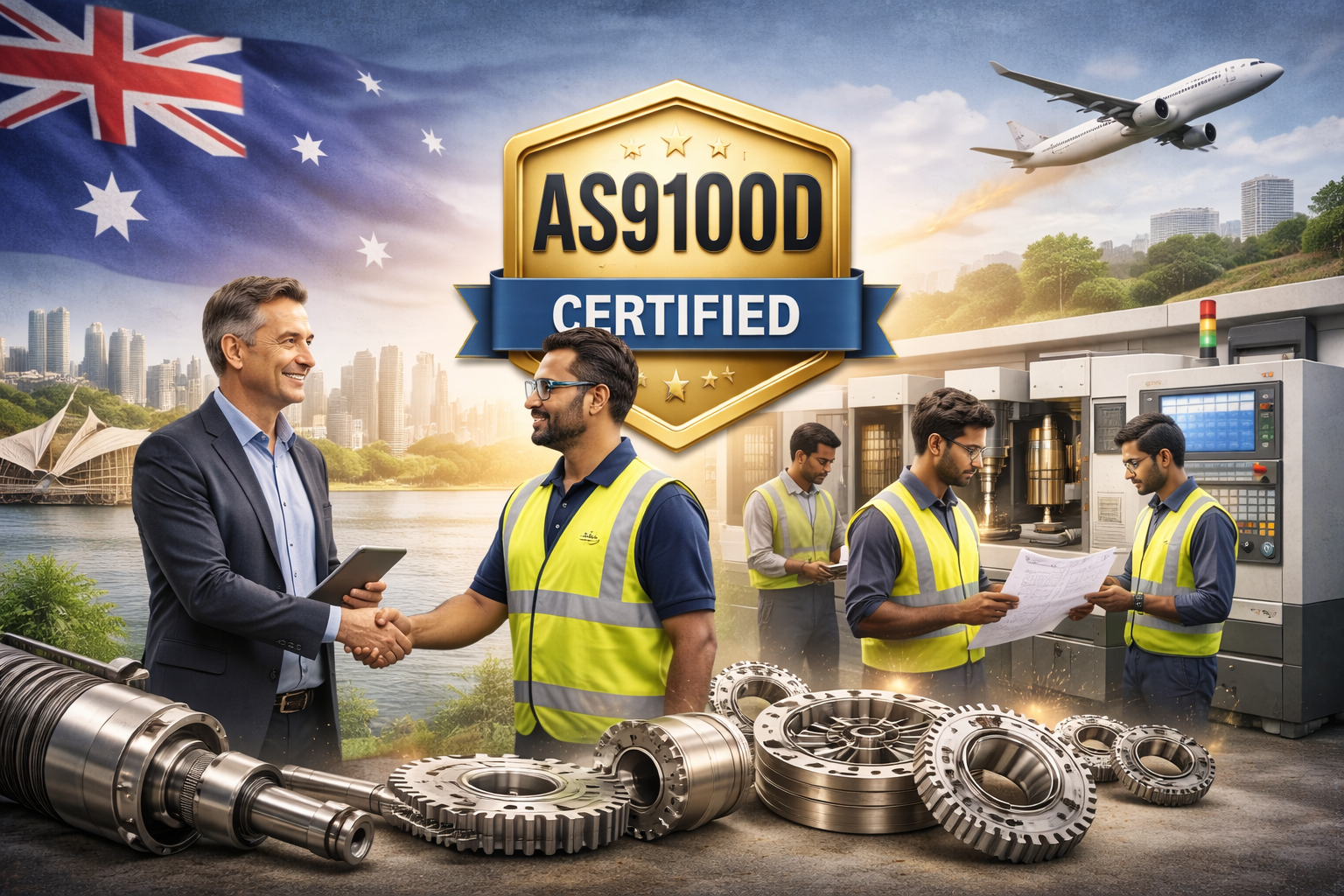
AS9100D isn't just another quality certification you can buy with a stamp and a handshake. It's the aerospace industry's equivalent of ISO 9001, but with significantly more stringent requirements specifically designed for aerospace manufacturing.
Breaking Down AS9100D Requirements
Let me explain what AS9100D certification actually requires, because this is where you separate genuine aerospace manufacturers from those just printing certificates:
Core AS9100D Requirements:
Complete Material Traceability
Every piece of material must be traceable back to the mill test certificate. If a component fails in service, you need to identify every other component from the same batch.
Configuration Management
Strict control over design changes. Any modification to a part requires documented approval and change control procedures.
First Article Inspection (FAI)
The first production run requires comprehensive inspection and documentation before mass production can begin. This isn't a quick check—it's a full verification of every dimension and specification.
Calibrated Equipment & Records
All measuring equipment must be calibrated against traceable standards, with complete records of calibration dates and results.
Special Process Control
Heat treatment, welding, coating, and other critical processes must be performed by qualified operators using approved procedures.
Foreign Object Debris (FOD) Prevention
Strict cleanliness requirements to prevent contamination that could cause component failure.
Counterfeit Parts Prevention
Documented procedures to prevent counterfeit or suspect materials from entering the production process.
These aren't suggestions—they're mandatory requirements that get audited regularly by independent certification bodies. An AS9100D facility in India follows exactly the same standards as one in Australia, the US, or Europe.
Who Issues AS9100D Certification?
This is important: AS9100D certification must come from an accredited certification body. In India, reputable manufacturers get certified by the same organizations that certify Australian and American facilities:
- SAI Global (Australian-based, widely recognized)
- BSI (British Standards Institution)
- TÜV (German certification body)
- DNV GL (Norwegian-based, aerospace specialist)
- Bureau Veritas
- Lloyd's Register
If an Indian manufacturer claims AS9100D certification but can't show you a certificate from one of these recognized bodies, walk away. It's not real certification.
The Quality Advantage: Why Indian AS9100D Facilities Excel
Here's something that surprises many Australian procurement managers: Indian AS9100D certified manufacturers often have MORE robust quality systems than smaller Australian shops.
Why? Because to compete internationally in aerospace, Indian manufacturers had to invest heavily in world-class quality infrastructure. They couldn't rely on proximity to customers or local relationships—they had to prove quality through documentation and certification.
Quality Infrastructure Comparison
| Quality Factor | Indian AS9100D Facility | Typical AU Shop |
|---|---|---|
| CMM (Coordinate Measuring Machine) | Standard Equipment | Some Facilities |
| Full Material Testing Lab | On-site | Outsourced |
| Climate-Controlled Inspection Room | Yes (20°C ±1°C) | Variable |
| Statistical Process Control (SPC) | Mandatory | Sometimes |
| Non-Destructive Testing (NDT) | In-house | Outsourced |
| Annual External Quality Audits | 3-4 per year | 1-2 per year |
Real Example:
An Adelaide aerospace contractor told me their Indian AS9100D supplier caught a material specification error in their drawings before production started. The Indian quality team noticed the specified aluminum alloy wouldn't meet the required strength at the operating temperature. Their local Australian shop had manufactured the same part three times without questioning it.
Cost Benefits Without Compromise
Let's address the elephant in the room: cost. Australian companies don't choose Indian manufacturers just for quality—they choose them because they get AS9100D-level quality at 30-40% lower costs than Australian suppliers.
Real Cost Comparison: Aerospace Brackets
Project: 200 Titanium Aerospace Brackets
Australian Manufacturer
$280,000
Indian AS9100D Manufacturer
$168,000
Total Savings: $112,000 (40%)
Plus 4 weeks faster delivery and higher certification level
Why the Cost Difference?
It's not about cutting corners—it's about operational efficiency and labor costs:
- • Labor costs: Skilled machinist in India earns $8,000-15,000/year vs $60,000-80,000 in Australia (same skill level, same AS9100D training)
- • Facility costs: Manufacturing space in India is 70-80% cheaper than Sydney or Melbourne
- • Scale economies: Large Indian aerospace facilities serve global markets, spreading fixed costs across larger volumes
- • ECTA benefits: 0% import duty under Australia-India trade agreement (saving 5% on landed costs)
ECTA Trade Agreement Advantage:
Under the Australia-India Economic Cooperation and Trade Agreement (effective December 2022), aerospace components from India enter Australia with 0% import duty. This adds another 5% to your cost savings compared to pre-2022.
On a $200,000 order, that's $10,000 in duty savings that you would have paid just two years ago—pure bottom-line benefit.
Communication & Engineering Support: The Secret Advantage
One of the biggest advantages Australian companies discover when working with Indian AS9100D manufacturers is something unexpected: superior communication and engineering support.
The English Language Advantage
English is an official language in India, and technical education is conducted in English. When you email an Indian aerospace engineer about tolerance stack-up or material substitution, you get clear, detailed responses in technical English—not translations or approximations.
Compare this to Chinese manufacturers where technical questions go through sales translators, creating a game of telephone that leads to costly misunderstandings.
Communication Quality Comparison:
Indian AS9100D Manufacturer:
- • Direct communication with engineering team
- • Technical English proficiency
- • Same-day responses to technical questions
- • Comfortable questioning specifications if they don't make sense
- • Design for manufacturability suggestions
Chinese Manufacturer (typical):
- • Communication through sales intermediaries
- • Translation delays and errors
- • 24-48 hour response times
- • Rarely question specifications (build what's specified)
- • Limited design feedback
Proactive Engineering Support
Indian aerospace engineers are trained to think critically about designs. They'll catch errors in your drawings, suggest cost-saving alternatives, and recommend manufacturing process improvements.
Real Example:
A Brisbane aerospace company was about to order 500 aluminum aircraft fittings with a complex 5-axis machining requirement. Their Indian AS9100D supplier reviewed the drawings and suggested a design modification that maintained all performance requirements but allowed 3-axis machining instead. This saved $45,000 on the order without any compromise to functionality or safety.
How to Verify AS9100D Certification (Don't Get Fooled)
Not all AS9100D certificates are legitimate. Here's your step-by-step verification process to ensure you're dealing with a truly certified facility:
AS9100D Verification Checklist:
Request the Certificate
Ask for a copy of their current AS9100D certificate. It should be dated within the last 3 years.
Check the Certification Body
Verify it's from a recognized body: SAI Global, BSI, TÜV, DNV GL, Bureau Veritas, or Lloyd's Register.
Verify Scope of Certification
The certificate should specify which processes are covered (e.g., "CNC machining of aerospace components"). Make sure it covers what you need.
Check Surveillance Audit Dates
AS9100D requires annual surveillance audits. Ask for proof of the most recent audit (should be within last 12 months).
Verify with Certification Body
Contact the certification body directly. Most have online verification tools where you can confirm a company's certification status.
Request Recent Audit Reports
Ask for non-conformance records from recent audits. A facility with zero non-conformances is suspicious—good facilities identify and fix issues.
Ask for Customer References
Request contacts for 2-3 aerospace customers they currently supply. Legitimate AS9100D manufacturers will have aerospace clients.
Real Australian Success Stories
Let me share three real examples of Australian companies successfully working with Indian AS9100D manufacturers:
Sydney Aerospace Component Manufacturer
Industry: Commercial Aviation | Component: Hydraulic System Fittings
Challenge: Needed 2,000 custom titanium fittings for a new aircraft hydraulic system. Australian quotes were $850,000 with 20-week lead time.
Solution: Partnered with Bangalore-based AS9100D certified manufacturer. Initial qualification took 6 weeks including FAI approval.
Result: Total cost $520,000 (39% savings), 14-week delivery. All parts passed incoming inspection first time. Now a 3-year supply agreement.
Adelaide Defence Contractor
Industry: Defence/Military | Component: Helicopter Rotor Components
Challenge: Australian Defence Force contract required AS9100D compliance and complete material traceability. Extremely tight tolerances (±0.005mm).
Solution: After rigorous audit, selected Mumbai facility with 20+ years aerospace experience and climate-controlled CMM inspection room.
Result: 100% pass rate on first article inspection. Defence auditors approved supplier without additional requirements. 32% cost savings maintained over 5-year contract.
Melbourne Space Technology Startup
Industry: Space/Satellite | Component: Satellite Structural Components
Challenge: Needed aerospace-grade aluminum components with anodizing for space environment. Limited budget as early-stage startup.
Solution: Indian AS9100D supplier provided design feedback to optimize for space conditions, suggested coating improvements, handled all special processing in-house.
Result: 44% cost savings vs Australian quotes allowed startup to complete satellite on budget. Components performed perfectly in thermal vacuum testing. Supplier became long-term partner.
Making the Right Choice for Your Aerospace Project
Australian aerospace and defence companies are choosing Indian AS9100D certified manufacturers not because they're desperate for cheap alternatives, but because they've discovered a combination of genuine quality, robust compliance, and significant cost savings.
The key differentiators that make Indian aerospace suppliers attractive are:
- Genuine AS9100D certification from recognized international bodies
- World-class quality infrastructure (CMM, material testing, NDT)
- English-speaking engineering teams providing proactive design support
- 30-40% cost savings without quality compromise
- ECTA duty-free benefits (additional 5% savings)
- Established track records with Australian aerospace contractors
Decision Framework:
Choose Indian AS9100D manufacturers when:
- • Order quantities justify qualification effort (typically 25+ units)
- • Lead time allows for 8-12 week delivery
- • Cost savings significantly impact project viability
- • You need proactive engineering support
- • AS9100D compliance is mandatory
Keep Australian suppliers when:
- • Need components in less than 4 weeks
- • Prototype quantities (under 10 units)
- • Design is still evolving rapidly
- • Client specifically requires Australian-made
The aerospace industry is global, and AS9100D certification creates a level playing field regardless of geography. Indian manufacturers have proven they can meet the same exacting standards as suppliers anywhere in the world—often with better quality infrastructure and at substantially lower costs.
For Australian aerospace and defence companies looking to remain competitive while maintaining uncompromising quality standards, Indian AS9100D certified manufacturers represent not just an alternative, but often the best choice.
Ready to Explore AS9100D Certified Indian Manufacturing?
Get a free consultation and detailed quote for your aerospace or defence components. We'll show you our AS9100D certification and connect you with our Australian aerospace clients.