
When planning a precision machining project, one of the first decisions you'll face is whether to use CNC milling or CNC turning. Both are fundamental machining processes that remove material to create precise components, but they operate in fundamentally different ways and excel at producing different types of parts.
Understanding the differences between milling and turning—including their capabilities, limitations, and ideal applications—is essential for optimizing your manufacturing approach. The right choice impacts not only the feasibility of producing your design but also project costs, lead times, and final part quality. This comprehensive guide demystifies CNC milling and turning, helping you make informed decisions for your precision machining projects.
What is CNC Milling?
CNC milling is a machining process where rotating cutting tools remove material from a stationary workpiece. The cutting tool—typically an end mill or face mill—rotates at high speeds while moving across the workpiece in multiple axes to create the desired geometry. Modern CNC mills operate in three, four, or five axes, enabling complex geometries and intricate features.
In milling operations, the workpiece is secured to the machine table or in a fixture, remaining stationary while the spinning cutting tool removes material. The tool can approach the workpiece from multiple directions and angles, making milling ideal for creating features like pockets, slots, contoured surfaces, and complex 3D geometries. Multi-axis mills can machine nearly all surfaces of a part in a single setup, though some features may remain inaccessible without repositioning.
Types of CNC Milling Operations
3-Axis Milling
The most common configuration, 3-axis mills move the cutting tool along X, Y, and Z axes while the tool remains vertically oriented. Ideal for parts with features accessible from the top, such as plates, brackets, and enclosures.
4-Axis Milling
Adds rotational movement around one axis (typically the X-axis), allowing the workpiece to rotate while the tool cuts. Enables machining of cylindrical features and continuous contouring around parts without manual repositioning.
5-Axis Milling
The most sophisticated configuration, 5-axis mills can tilt and rotate the tool or workpiece in two additional rotational axes. Enables single-setup machining of highly complex parts with features at compound angles, dramatically reducing setup time and improving precision.
Common Milling Applications
Milling excels at producing parts with flat surfaces, pockets, holes at various angles, slots, complex contours, and intricate 3D geometries. Typical applications include:
- Engine blocks
- Aerospace structural components
- Molds and dies
- Electronics enclosures
- Custom brackets and fixtures
- Prototypes of virtually any geometry
Key Insight: The versatility of milling makes it the go-to process for parts that don't feature primarily cylindrical geometries.
What is CNC Turning?
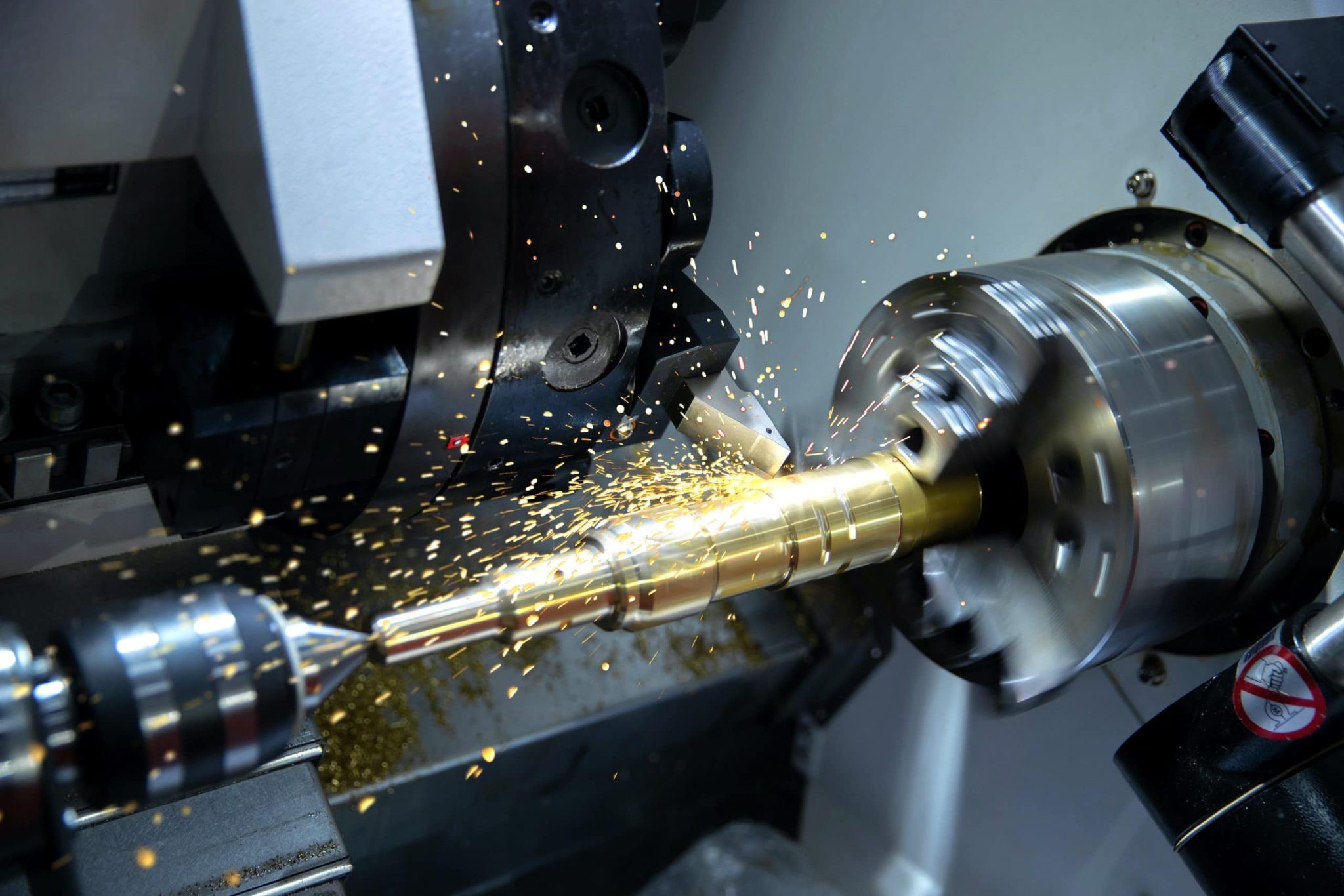
CNC turning is a machining process where the workpiece rotates while a stationary cutting tool removes material to create cylindrical parts. The workpiece is held in a chuck or collet and spins at high speed while the cutting tool moves linearly along the length and occasionally across the face of the rotating part. This process is performed on CNC lathes or turning centers.
During turning operations, material removal occurs as the workpiece rotates against the cutting tool. The tool can move parallel to the rotation axis (creating cylindrical features), perpendicular to it (facing operations), or at angles (creating tapers and contours). The fundamental geometry created through turning is cylindrical, making it the natural choice for shafts, pins, bushings, and other round components.
Types of CNC Turning Operations
External Turning
Reduces the external diameter of the workpiece to create cylindrical shapes, tapers, contours, and steps. The most common turning operation, used to create shafts, pins, and the external features of bushings and sleeves.
Boring
Enlarges existing holes or creates internal cylindrical features within a workpiece. Essential for creating precise internal diameters in bushings, bearing housings, and cylindrical cavities with tight tolerance requirements.
Facing
Creates flat surfaces perpendicular to the rotation axis, typically on the ends of cylindrical parts. Facing operations establish reference surfaces and achieve precise length dimensions.
Threading
Cuts internal or external threads onto cylindrical surfaces. CNC lathes can produce precise, consistent threads for fastening applications, with control over pitch, depth, and thread form.
Grooving and Parting
Grooving cuts narrow channels into the workpiece surface, while parting separates the completed part from remaining stock material. Both operations use specialized narrow tools for precise, clean cuts.
Common Applications
Any part with predominantly cylindrical geometry, especially those requiring high concentricity or precise internal/external diameter relationships, benefits from turning operations.
Key Differences Between Milling and Turning
Fundamental Operating Principles
The most fundamental difference lies in what rotates during machining:
CNC Milling
The cutting tool rotates while the workpiece remains stationary (or moves linearly)
CNC Turning
The workpiece rotates while the cutting tool remains stationary (or moves linearly)
This fundamental difference determines the geometries each process can efficiently create and influences material removal rates, surface finishes, and accuracy characteristics.
Part Geometry and Capabilities
Milling Capabilities
- ✓ Complex prismatic parts
- ✓ Pockets, slots, holes at various angles
- ✓ Intricate 3D contours
- ✓ Organic curves and compound angles
- ✓ Features accessible from multiple directions
- ✗ Struggles with deep, narrow holes
- ✗ Long, slender shafts can deflect
Turning Capabilities
- ✓ Cylindrical geometries
- ✓ Round external profiles
- ✓ Internal bores and threads
- ✓ Symmetrical features around central axis
- ✓ Superior concentricity maintenance
- ✗ Cannot create non-symmetrical features
- ✗ Limited to cylindrical/rotational geometry
Material Removal Rates
Turning Advantages
Generally achieves higher material removal rates when reducing external diameters or creating internal bores. The continuous cutting action enables aggressive material removal, particularly on cylindrical parts.
- • Continuous cutting action
- • High feed rates possible
- • Large diameter reductions quick
Milling Considerations
Material removal rates depend heavily on part geometry and machine capability. Modern high-speed milling achieves impressive removal rates for pockets and prismatic features.
- • Varies with part complexity
- • Excellent for pocket removal
- • Complex 3D requires lighter cuts
Surface Finish and Accuracy
Both processes can achieve excellent surface finishes and tight tolerances, but their characteristics differ:
| Characteristic | CNC Turning | CNC Milling |
|---|---|---|
| Surface Finish | Superior on cylindrical surfaces due to continuous cutting | Exceptional on flat and contoured surfaces |
| Concentricity | Naturally maintained (all features around same axis) | More challenging to achieve |
| Cylindricity | Excellent - critical for rotating parts | May show tool marks on holes |
| Complex Surface Relationships | Limited to rotational symmetry | Excels at maintaining relationships at various orientations |
When to Use CNC Milling
Ideal Milling Applications
Choose milling for parts with primarily prismatic (box-like) geometries requiring flat surfaces, pockets, slots, or complex 3D contours. Milling is ideal when your part needs holes or features at various angles, when features don't share a common central axis, or when creating complex organic shapes that don't fit traditional geometric categories.
Milling is Particularly Advantageous For:
- Prototyping complex designs
- Creating molds and dies with intricate cavity details
- Producing aerospace components with weight-reduction pockets and complex geometries
- Manufacturing enclosures and housings with mounting features
- Creating custom brackets or structural components with optimization for strength-to-weight ratios
Advantages of Milling
Geometric Versatility
Can create virtually any geometry including complex curves, compound angles, and organic shapes.
Multi-Feature Capability
Easily machines multiple non-cylindrical features in various orientations within a single setup.
Large Part Capacity
Mills can accommodate large, heavy workpieces that would be impractical to rotate on a lathe.
Irregular Stock Shapes
Can work with plate stock, castings, forgings, and irregularly shaped raw materials.
Limitations of Milling
- • Deep, narrow features: Tool length-to-diameter ratios become problematic, leading to deflection and chatter
- • Long, slender parts: Can deflect under cutting forces, making precise dimensional control difficult
- • High concentricity requirements: More challenging than turning for maintaining alignment between cylindrical features
- • Internal threads: Often require multiple operations or specialized tooling
- • Cylindrical part inefficiency: For parts primarily consisting of cylindrical geometries, milling is typically slower and more expensive than turning
- • Setup complexity: Longer setup times when multiple orientations required; programming complexity increases significantly for intricate 3D contours
When to Use CNC Turning
Ideal Turning Applications
Choose turning for parts with primarily cylindrical geometries including shafts, pins, bushings, sleeves, and any component where concentricity is critical. Turning is ideal when your part consists mainly of external or internal cylindrical features, when maintaining precise diameter relationships is essential, or when producing threaded components.
Turning Excels At Creating:
- Rotating components for motors and actuators
- Hydraulic and pneumatic cylinders and pistons
- Precision bearings and bearing journals
- Threaded fasteners and fittings
- Automotive drivetrain components
The process naturally maintains concentricity and cylindricity, making it superior for parts where these characteristics are functionally critical.
Advantages of Turning
Superior Concentricity
All cylindrical features are naturally concentric since they're machined around the same rotation axis.
High Material Removal
Continuous cutting action enables aggressive material removal rates, especially for diameter reduction.
Excellent Surface Finish
Continuous cutting produces smooth, consistent surface finishes on cylindrical surfaces.
Threading Capability
Produces precise internal and external threads directly without specialized attachments.
Cost Efficiency
For cylindrical parts, turning is typically faster and less expensive than milling equivalent features.
Long Part Support
Tailstocks and steady rests support long, slender workpieces effectively during machining.
Limitations of Turning
- • Geometry limitations: Limited to parts that are primarily cylindrical or can be oriented around a central axis
- • Non-symmetrical features: Flat surfaces, pockets, or features at angles to the rotation axis cannot be created through pure turning
- • Irregular shapes: Parts with square, rectangular, or irregular external shapes aren't suitable for turning
- • Fixturing constraints: Workpiece must be securely held in chuck or between centers, limiting size and weight that can be safely rotated
- • Large diameter challenges: Very large diameter parts may be impractical or impossible to turn due to rotational speed limitations
- • Complex internal cavities: Features beyond simple bores require alternative processes
Mill-Turn Centers: The Best of Both Worlds
Modern manufacturing has produced hybrid machines called mill-turn centers that combine milling and turning capabilities in a single platform. These sophisticated machines feature a rotating spindle (like a lathe) plus live tooling that can mill, drill, and perform other operations while the workpiece rotates or is indexed to specific positions.
Advantages of Mill-Turn Technology
Mill-turn centers excel at producing complex parts requiring both cylindrical and non-cylindrical features. A single setup can complete turned features like external diameters and bores along with milled features like flats, slots, cross-holes, and keyways.
Key Benefits:
- • Single setup eliminates part transfers
- • Improved accuracy with single fixture reference
- • Reduced handling time
- • 40-60% reduction in total production time
Ideal Applications:
- • Complex hydraulic components
- • Aerospace fittings
- • Medical implants
- • Parts with both cylindrical and sculpted features
When Mill-Turn Makes Sense
Consider mill-turn processing for parts with:
- Predominantly cylindrical geometry plus critical milled features
- Cross-holes precisely positioned relative to turned features
- Flat surfaces or keyways on cylindrical components
- Complex angled features that must align with cylindrical datums
- When part complexity would otherwise require three or more separate setups
While mill-turn machines represent significant capital investment and require skilled programming, they deliver substantial value for appropriate applications. Australian manufacturers serving aerospace, medical device, and high-precision industries increasingly leverage mill-turn technology to deliver complex parts with superior accuracy and reduced lead times.
Cost Considerations: Milling vs Turning
Setup and Programming Costs
CNC Turning
- • Typically simpler programming for standard cylindrical features
- • Complex contours increase programming time
- • Straightforward fixture requirements (standard chucks/collets)
- • Setup generally faster for cylindrical parts
CNC Milling
- • Programming complexity scales with part geometry
- • Simple prismatic parts: minimal programming
- • Complex 3D contours: significant CAM programming time
- • May require custom fixtures for complex geometries
Production Speed and Efficiency
Turning Efficiency
For cylindrical parts, turning is typically faster and more cost-effective. The continuous cutting action and high material removal rates mean producing a shaft or bushing on a lathe takes significantly less time than creating equivalent features through milling.
When part quantities justify setup costs, turning delivers excellent per-piece economics.
Milling Efficiency
Efficiency depends heavily on part complexity and geometry. For parts requiring features in multiple orientations, modern multi-axis mills can complete entire components in single setups.
However, intricate 3D toolpaths and fine finishing operations can extend cycle times substantially.
Material Waste and Optimization
Both processes are subtractive, creating waste material (chips) as features are cut. Optimization strategies include:
- • Turning from round bar: Highly efficient when part diameter approaches stock diameter
- • Milling from plate/block: Waste proportional to material removed
- • Near-net-shape materials: Castings, forgings, or extrusions minimize waste in both processes
- • High-value materials: For titanium or Inconel, optimizing stock selection significantly impacts cost
Material Considerations
Material-Process Interactions
Both milling and turning can process virtually any machinable material, but certain materials present specific challenges:
Soft Materials (Aluminum, Copper)
Can create built-up edge on cutting tools, affecting surface finish.
Advantage: Often machine better in turning operations where continuous cutting helps prevent buildup.
Hard Materials (Stainless, Titanium)
Generate significant cutting heat and tool wear in both processes.
Considerations: Turning's continuous engagement accelerates tool wear; milling's interrupted cutting allows cooling but creates cyclical loading.
Stock Form and Availability
Material availability in appropriate stock forms influences process selection:
- Round bar stock: Ideal for turning operations
- Plate, sheet, and block stock: Suit milling operations
- Australian availability: Some specialty materials or specific sizes may require international sourcing with extended lead times
- Near-net-shape materials: Castings, forgings, or extrusions reduce machining time and material waste (justified at higher volumes)
Decision Framework: Choosing the Right Process
Questions to Guide Your Decision
1. What is the primary geometry?
If predominantly cylindrical, lean toward turning. If prismatic or complex 3D shapes, choose milling.
2. Is concentricity critical?
Turning maintains superior concentricity for rotating components and bearing surfaces.
3. What features are required?
Threads, precise bores, and concentric diameters favor turning. Pockets, slots, and angled features favor milling.
4. What stock material is available?
Round stock suits turning; plate, block, or irregular shapes suit milling.
5. What production volume is required?
Both processes scale effectively, but consider setup amortization across quantity.
6. Does the part require both turned and milled features?
Consider mill-turn centers or sequential operations on separate machines.
Working with Manufacturing Partners
The best manufacturing partners provide process guidance during design and quoting phases. Share your part requirements early—experienced machinists can identify optimal process selection and suggest design modifications that improve manufacturability without compromising function.
Many parts benefit from hybrid approaches, using turning for cylindrical features and milling for additional details. Understanding capabilities of both processes allows designers to leverage their respective strengths. Open communication with manufacturers ensures your parts are produced using the most efficient, cost-effective methods.
Design for Manufacturability Principles
Regardless of which process you choose, designing with manufacturing in mind optimizes outcomes:
Design for Milling
- ✓ Avoid unnecessary tight tolerances
- ✓ Provide adequate tool access
- ✓ Use standard tool sizes where possible
- ✓ Minimize the number of setups required
- ✓ Consider tool reach and deflection
- ✓ Use appropriate corner radii for tool clearance
Design for Turning
- ✓ Design around standard material stock sizes
- ✓ Avoid unnecessarily deep or complex internal features
- ✓ Consider how the part will be held during machining
- ✓ Maintain consistent wall thickness where possible
- ✓ Use standard thread forms and pitches
- ✓ Specify realistic surface finish requirements
Best Practice: Early Manufacturer Engagement
Engage manufacturers early in the design process to identify potential issues before finalizing designs. Simple modifications—adjusting radii, relocating features, or modifying tolerance requirements—can dramatically reduce manufacturing costs and lead times without impacting part functionality.
The most successful projects involve collaboration between designers and manufacturers from the conceptual phase through production, ensuring designs are optimized for the most appropriate manufacturing processes.
Fedele Autocore's Comprehensive Machining Capabilities
At Fedele Autocore, we maintain state-of-the-art CNC milling and turning equipment to serve diverse manufacturing requirements. Our engineering team evaluates each project to determine the optimal process—or combination of processes—to deliver parts that meet specifications while minimizing costs and lead times.
Whether your project requires multi-axis milling for complex aerospace components, precision turning for high-accuracy cylindrical parts, or mill-turn operations for parts combining both geometries, our capabilities and expertise ensure optimal outcomes. We work collaboratively with clients during design phases, providing manufacturability feedback and process recommendations that improve quality while controlling costs.
Conclusion
CNC milling and turning represent complementary rather than competing processes. Each excels at specific applications determined by part geometry, feature requirements, and functional needs. Understanding their fundamental differences—what rotates, what geometries they create, and where they deliver advantages—enables informed decision-making that optimizes manufacturing outcomes.
Modern manufacturing increasingly leverages both processes, either sequentially or through mill-turn centers that combine capabilities in single machines. The key to successful manufacturing lies not in declaring one process superior but in matching process capabilities to part requirements. Cylindrical parts benefit from turning's speed and concentricity; complex prismatic parts require milling's geometric versatility.
By engaging manufacturing partners early in design phases and remaining flexible about process selection, you ensure parts are produced efficiently using appropriate technologies. The result is higher quality components, reduced costs, and faster delivery—exactly what precision manufacturing partnerships should deliver.
Expert Guidance for Your Machining Projects
Need help determining whether milling, turning, or a hybrid approach is right for your project? Fedele Autocore's engineering team provides expert process guidance and design feedback. Contact us to discuss your requirements and discover how our comprehensive machining capabilities deliver optimal results.
Related Resources
Surface Finishing Options for Australian CNC Components
Comprehensive guide to anodizing, powder coating, and other finishing processes.
India vs China CNC Machining for Australian Projects
Compare quality, costs, and capabilities for offshore CNC sourcing.
Hidden Costs in Australian CNC Machining Projects
Learn how to specify appropriate tolerances for your manufacturing projects.
Explore Our CNC Machining Services
Multi-axis milling, precision turning, and mill-turn capabilities for Australian manufacturers.